Pet food: Morocco imports 15 times more than in 2010
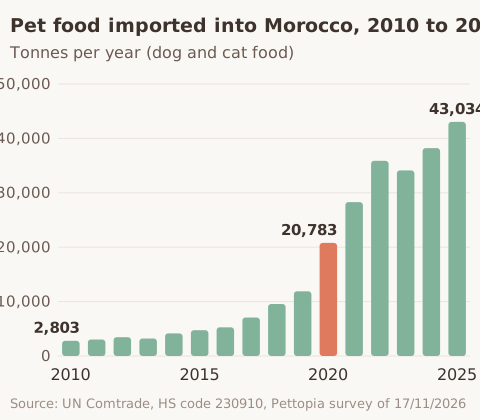
In 2010, Morocco imported 2,803 tonnes of dry and wet food for dogs and cats. In 2025, it imported 43,034 tonnes: 15 times more. The price of a kilo at the Moroccan border has also risen 42% since 2020. These figures come from Moroccan customs. We collected them and laid them out, year by year.
Method
- Source: the United Nations' UN Comtrade database. It records what each country's customs declare. Here, what Morocco declares it imported.
- Product: customs code 230910, "dog or cat food, put up for retail sale". That is kibble, wet food and treats in packs.
- Not counted: food made in Morocco, bags brought back in a suitcase, and food sold in bulk.
- Amounts: the value declared at the Moroccan border, in US dollars, shipping to the border included. Customs duties, VAT and sellers' margins come on top. Weight is net weight.
- Date: collected on 17 November 2026. 2025 is the latest year declared.
15 times more in 15 years
| Year | Tonnes | Million dollars |
|---|---|---|
| 2010 | 2,803 | 3.38 |
| 2011 | 3,028 | 4.10 |
| 2012 | 3,453 | 4.42 |
| 2013 | 3,212 | 4.56 |
| 2014 | 4,156 | 6.09 |
| 2015 | 4,744 | 5.88 |
| 2016 | 5,278 | 6.92 |
| 2017 | 7,079 | 9.39 |
| 2018 | 9,560 | 11.98 |
| 2019 | 11,886 | 14.10 |
| 2020 | 20,783 | 23.61 |
| 2021 | 28,294 | 34.79 |
| 2022 | 35,881 | 47.38 |
| 2023 | 34,111 | 52.69 |
| 2024 | 38,221 | 57.91 |
| 2025 | 43,034 | 69.90 |
2020 is the year of the jump. Morocco imported 20,783 tonnes, against 11,886 in 2019: 75% more in one year. Volume rose another 36% in 2021, then 27% in 2022.
Only one fall since 2013. In 2023, volume fell 5%. But value rose 11% the same year: Morocco paid more for less food. Volume grew again in 2024 and 2025.
2020 was also the year of lockdowns. Customs figures do not say why imports jumped that year.
Where the food comes from
In 2025, eight countries supply 97.5% of the value:
| Country | Share of value | Tonnes | Price of a kilo at the border |
|---|---|---|---|
| France | 30.2% | 7,627 | 2.77 dollars |
| Spain | 16.3% | 8,519 | 1.34 dollars |
| Italy | 12.6% | 6,642 | 1.33 dollars |
| Poland | 11.6% | 5,889 | 1.38 dollars |
| Portugal | 11.1% | 7,081 | 1.09 dollars |
| Hungary | 7.3% | 2,737 | 1.87 dollars |
| Türkiye | 4.6% | 2,793 | 1.15 dollars |
| Netherlands | 3.8% | 1,230 | 2.16 dollars |
France sells at the highest price, Spain ships the most. In 2015, France supplied 65% of the value. In 2025, 30%. It is still first by value, but Spain ships more tonnes (8,519 against 7,627), and Portugal almost as many (7,081).
A French kilo costs two and a half times a Portuguese kilo. It reaches Morocco at 2.77 dollars, against 1.09 dollars for a Portuguese kilo. Customs do not say what is in the bag: a higher price can come from the recipe, the brand or the format (small packs, wet food).
Poland arrived within ten years. It was not among the suppliers in 2015. In 2025, it supplies 12% of the value.
The price of a kilo is rising
The average price of a kilo at the Moroccan border went from 1.14 dollars in 2020 to 1.62 dollars in 2025: 42% more. The kilo you pay in a shop costs much more, after duties, VAT, transport and margins: 57 to 121 DH depending on the brand, against 15 DH at the border. The calculation is in our article on pet food prices, from the border to the shop.
What this means for you
- Compare the price per kilo, not the price of the bag. A large bag looks expensive but often costs less per kilo. Do the maths before you buy.
- A high price does not tell you everything. Country of origin and price are not enough to judge a food. Read the ingredients: our page on feeding dogs and cats in Morocco explains what to look for.
- Food is the cost that comes back every month. Before adopting, put it in your budget. Our article on the cost of a pet in Morocco lists the other costs, and the Matcher helps you choose an animal that fits your life.
What we do not know
- Production in Morocco. Dog and cat food made in Morocco is not in these figures. We found no public source that gives its volume.
- The split between dogs and cats. The customs code groups both.
- Purchases outside customs. Bags brought back from travel or sold without a declaration are not counted.
We will repeat this survey every year, as soon as customs publish the previous year's figures.