Which Pet Matches You? The Science Behind the Test
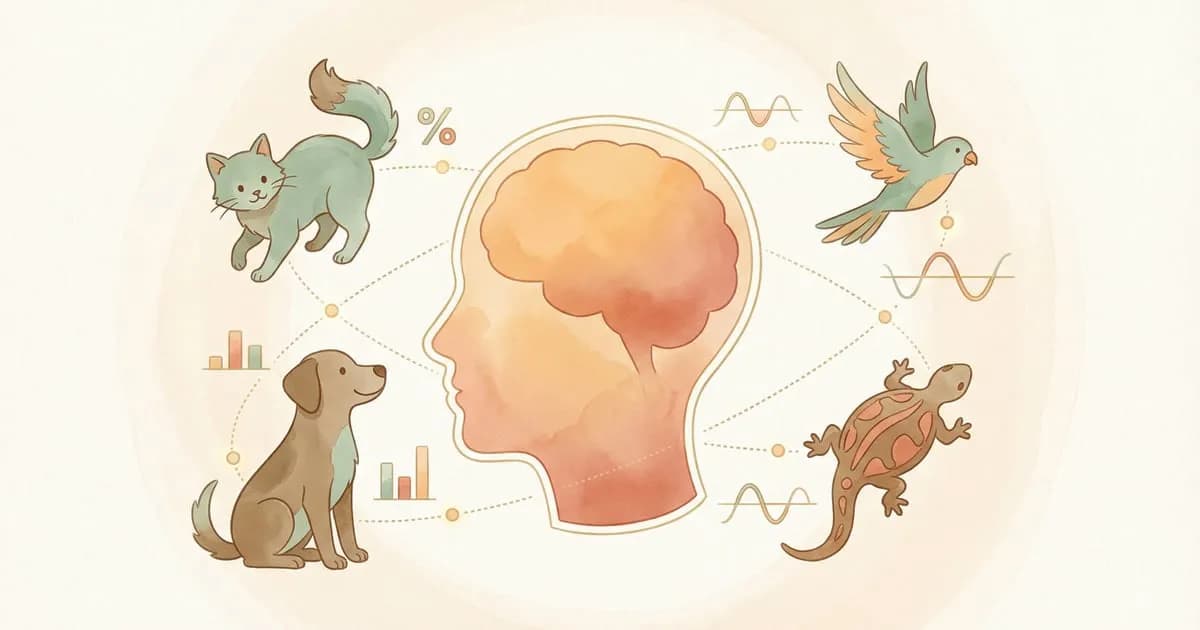
Watch the test in action
How Do You Choose the Right Animal?
Many people get a pet on impulse, because it's cute, a friend has one, or the timing seems right. Then six months later comes frustration: the dog barks too much, the cat isn't affectionate, the animal just doesn't fit.
The truth? There's a science behind human-animal compatibility. And it starts with your personality. We explore this connection in depth in our article on human-animal personality.
The Big Five: The Foundation of Modern Psychology
Since the 1990s, psychologists have used the Big Five model (the Five Grand Traits) to describe personality. This model is validated by thousands of studies and used in recruitment, relationships, and yes, choosing a pet.
The five traits are:
1. Openness
Are you curious, creative, a lover of new experiences? Or traditional, practical, cautious?
- High openness: "I love trying weird things", "I'm creative", "I change my mind easily"
- Low openness: "I love routines", "I'm pragmatic", "I prefer stability"
2. Conscientiousness
Are you organized, responsible, faithful to commitments? Or spontaneous, carefree, flexible?
- High conscientiousness: "I make lists", "I'm dependable", "Duty comes first"
- Low conscientiousness: "I go with the flow", "Freedom attracts me", "Rules aren't for me"
3. Extraversion
Are you energetic, sociable, talkative? Or introverted, reserved, contemplative?
- High extraversion: "I'm the life of the party", "I love people", "Action all the time"
- Low extraversion: "I'm better alone", "I observe more than speak", "Solitude recharges me"
4. Agreeableness
Are you empathetic, cooperative, generous? Or competitive, critical, independent?
- High agreeableness: "I put others first", "I avoid conflict", "Empathy is my strength"
- Low agreeableness: "I'm independent", "Competition motivates me", "I tell the truth even if it's tough"
5. Neuroticism
Are you anxious, emotional, sensitive to stress? Or calm, stable, unbothered?
- High neuroticism: "I worry a lot", "I'm sensitive", "Uncertainty stresses me"
- Low neuroticism: "I'm cool", "It is what it is", "I handle stress easily"
How Does This Apply to Animals?
Every animal has a "personality" too: its needs, energy, temperament. And compatibility is obvious:
Cats for Introverts
Cats don't demand constant social walks. They appreciate introverts who respect their space and enjoy quiet. A cat and a very introverted person? Perfect match.
Dogs for Extraverts
Dogs want social interaction (park walks, play, meeting other dogs). A dog and an energetic, sociable, active person? Guaranteed happiness.
Exotic Animals for the Curious
Reptiles, unusual rodents, rare birds? These attract people with high openness, those who love constant learning and new experiences.
Shelter Animals for the Conscientious
Highly conscientious people find meaning in adopting a suffering animal. Their sense of duty and responsibility makes them exceptional adopters.
Pettopia's 8 Archetypes
But the Big Five alone is too abstract. That's why Pettopia created 8 archetypes, concrete profiles combining Big Five traits with myths and recognizable personalities. These profiles also draw from the concept of a totem animal, a cultural lens on the human-animal bond.
Each archetype corresponds to an ideal animal.
The Visionary (Low E, High O, High C)
Traits: Introverted but creative, deep thinker, visionary, long-term analyst.
You see the big picture. You think before acting. You love complex ideas and innovative solutions.
Ideal animal: Russian Blue Cat
Why? Russian Blues are reflective, observant, and offer profound (non-noisy) connection to their owner. They suit introverted thinkers perfectly.
Research citation: "Introverted creatives find comfort in low-energy pets who don't demand social performance." - Frontiers in Psychiatry 2024[1]
The Innovator (High E, High O, Low C)
Traits: Extraverted, creative, impulsive, loves stimulation, improvises.
You're change in action. You love surprises, experimenting, creating (creative) chaos.
Ideal animal: Parrot
Why? Parrots are energetic, demanding, unpredictable, and love constant interaction. Perfect for someone who craves adventure and novelty.
Citation: "Highly interactive animals foster cognitive engagement and emotional enrichment in extraverted owners." - MDPI Animals 2025[2]
The Architect (Low E, High O, High C)
Traits: Introverted analyst, perfectionist, thoughtful, system builder.
You love order, logic, and structures. You're meticulous and methodical.
Ideal animal: Reptile (Snake, Lizard)
Why? Reptiles demand deep understanding of specific needs, carefully calibrated habitats, and logical care protocols. Perfect for an architectural mind.
The Commander (High E, Low O, High C)
Traits: Extraverted, pragmatic, natural leader, organized, demands respect.
You make decisions, organize others, love structure and authority.
Ideal animal: Working Dog (German Shepherd, Husky)
Why? These dogs need a strong, clear leader. They respond well to structure and commands. A Commander appreciates a relationship built on mutual respect and training.
Citation: "High-dominance owners better manage dogs requiring clear direction." - Frontiers in Psychiatry 2024[1]
The Harmonizer (High E, Low O, Low C)
Traits: Extraverted, empathetic, spontaneous, loves emotional connection, flexible.
You put people (and animals) at your heart. You're the natural healer, the one who calms tensions.
Ideal animal: Golden Retriever
Why? Golden Retrievers embody canine empathy. They love people unconditionally and offer pure emotional connection. Perfect for a Harmonizer.
Citation: "Oxytocin (bonding hormone) increases during interactions with affectionate dogs. Highly empathetic owners benefit most from this chemistry." - Frontiers in Psychology 2024[3]
The Authentist (Low E, High O, Low O)
Traits: Introverted creative, nonconformist, independent, authentic, slightly rebellious.
You follow your own path. Social norms interest you little. You seek raw truth.
Ideal animal: Shelter Dog (Rescue Mix)
Why? Shelter dogs are authentic survivors, unpretentious. An Authentist sees in them a raw beauty transcending pedigree. Together, you live a true story.
The Guardian (Low E, Low O, High C)
Traits: Introverted, pragmatic, loyal, responsible, protective, stable.
You're the pillar. People can count on you. You take commitment seriously.
Ideal animal: Bulldog / Tortoise
Why? These animals demand constant presence, faithful routine, and real responsibility. A Guardian finds meaning in being indispensable to their animal.
Citation: "Highly conscientious owners report greater satisfaction when adopting animals with specific care needs." - MDPI Animals 2025[2]
The Dynamo (High E, Low O, Low C)
Traits: Extraverted, pragmatic, impulsive, competitive, energetic.
You live in motion. Action, challenge, competition motivates you.
Ideal animal: Bengal Cat / Husky
Why? These animals are pure dynamism themselves. They need movement, challenge, and constant engagement. A Dynamo appreciates a companion that can keep pace.
How Pettopia's Test Works
The Pettopia test asks 8-10 conversational questions. Each answer subtly evaluates your level on the 5 Big Five traits.
After each response, the test silently recalculates your scores: E (Extraversion), O (Openness), C (Conscientiousness).
By the end, it determines your most probable archetype and recommends your ideal animal, with complete scientific explanation.
The advantage? The test isn't a simple questionnaire. It's a natural conversation that understands your life context.
The Science Behind Twin Archetypes
Two archetypes, the Visionary and the Architect, share the same trait combination (Low E, High O, High C). They're differentiated by one crucial cognitive detail:
- Visionary: Thinks in synthesis (intuition, big-picture connections)
- Architect: Thinks in analysis (logic, detail, systems)
The test detects this through language and response context. It's subtler science, but it works.
Ready to Discover Your Archetype?
Science says: there's a perfect animal for your personality. Not for everyone, but for you.
Start the test now and discover your archetype in 5-10 minutes. Then explore all 8 ideal animals and see which truly resonates with you. You can also discover what animal represents you based on your temperament.
Sources:
[1] Campbell, D. J., & Haupt, M. A. (2024). "Canine cognition and human attachment: A review." Frontiers in Psychiatry, 15(1406590). https://www.frontiersin.org/journals/psychiatry/articles/10.3389/fpsyt.2024.1406590/full
[2] Beetz, A., Uvnäs-Moberg, K., Julius, H., & Kotrschal, K. (2025). "Human-animal interactions: Mechanisms and therapeutic potential." MDPI Animals, 15(13), 1895. https://www.mdpi.com/2076-2615/15/13/1895
[3] Plšková, A., & Franěk, M. (2025). "Pet ownership and mental health outcomes." Frontiers in Psychology, 15(1354220). https://www.frontiersin.org/journals/psychology/articles/10.3389/fpsyg.2024.1354220/full